Shared, Electric, Connected, & Automated Vehicle Testing
CE-CERT evaluates the four pillars of decarbonized mobility through advanced testbeds, simulation environments, instrumented vehicles, and real-world roadway infrastructure.
Researchers and partners can assess the performance, efficiency, energy, emissions, safety, and mobility impacts of next-generation transportation systems under dynamic and repeatable conditions.
Research and Impact
CE-CERT combines field-tested platforms, hardware-in-the-loop simulation, transportation modeling, and real-world infrastructure to support scalable, low-carbon mobility solutions.
Evaluate shared mobility strategies and operational models that can reduce reliance on individual vehicle travel.
Study battery-electric, plug-in hybrid, and hydrogen fuel-cell transportation across passenger and freight applications.
Use connected and automated vehicle technologies to improve traffic flow and reduce transportation energy use.
Connect adaptive traffic management, roadway communications, simulation, sensing, and emissions monitoring.
Testing Platforms and Testbeds
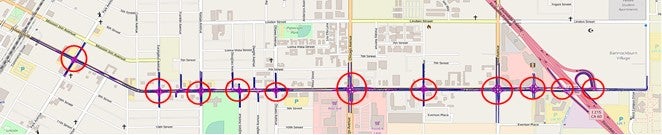
Riverside Innovation Corridor
A six-mile University Avenue corridor connecting UC Riverside and downtown Riverside provides instrumented intersections, connected traffic signals, roadside communications, sensing, and data collection for shared, electric, connected, and automated vehicle research.
Learn more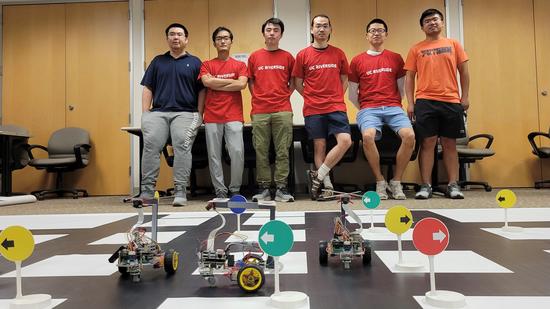
Connected Vehicle Fleet
CE-CERT’s connected vehicle platforms support field validation, vehicle-to-vehicle and vehicle-to-infrastructure communications, cooperative driving, data collection, and evaluation of emerging mobility applications.
Learn more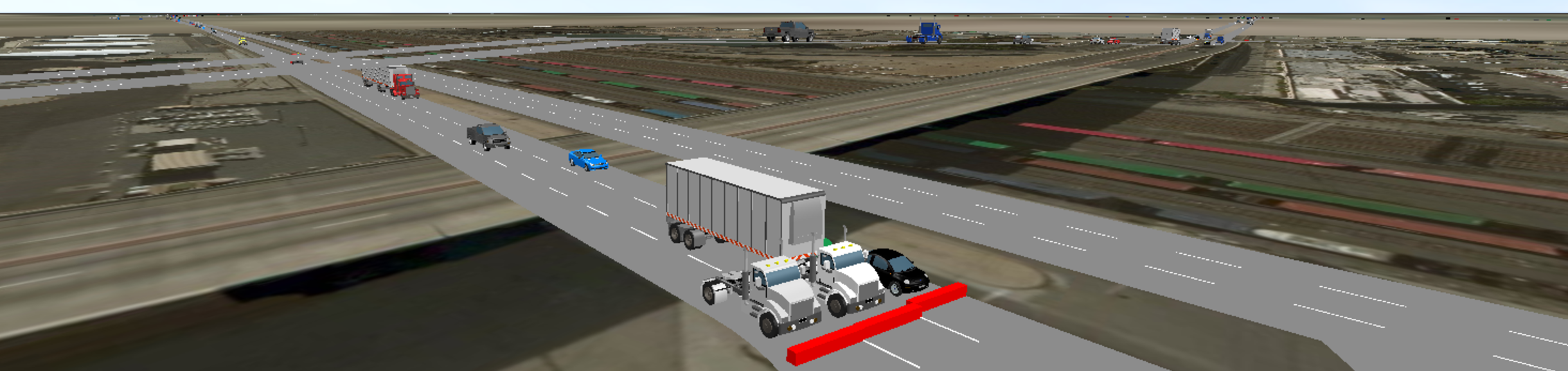
Driving Simulator Systems
High-fidelity driving simulators combine game-engine environments, virtual reality, driver controls, and transportation models to study human behavior, driver assistance, energy efficiency, and connected and automated vehicle applications.
Learn moreTesting Services
01 Shared Mobility Evaluation Model travel demand, operations, and system performance across shared mobility scenarios.
Evaluate Shared Mobility at System Scale
Using the Behavior, Energy, Autonomy, and Mobility model, known as BEAM, CE-CERT can evaluate travel demand and activity across shared mobility scenarios. The work can compare operational strategies and measure transportation, energy, and environmental performance.
Testing Applications
- Shared vehicle deployment scenarios
- Travel demand and activity analysis
- Vehicle miles traveled evaluation
- Energy and environmental performance
- Operational strategy comparison
02 Connected and Automated Vehicle Simulation Test connected and automated vehicle concepts before field deployment.
Simulation Across Traffic and Vehicle Environments
CE-CERT uses transportation simulation tools such as VISSIM, PARAMICS, and SUMO, along with specialized application programming interfaces, to evaluate connected and automated vehicle scenarios across a wide range of traffic conditions.
Testing Applications
- Microscopic traffic simulation
- Connected vehicle applications
- Automated driving scenarios
- Traffic-flow and energy analysis
- Custom model and application integration
03 Hardware-in-the-Loop Testing Connect traffic simulation with a physical vehicle operating on a dynamometer.
Bridge Simulation and Physical Vehicle Testing
CE-CERT’s hardware-in-the-loop system combines traffic simulation with a real vehicle operating on a dynamometer. This approach allows researchers and partners to test connected and automated vehicle behavior under repeatable virtual traffic conditions while collecting data from physical vehicle hardware.
Testing Applications
- Vehicle and traffic-system interaction
- Repeatable connected vehicle testing
- Control-system evaluation
- Energy and emissions assessment
- Predeployment technology validation
04 On-Road Connected and Automated Vehicle Testing Evaluate mobility technologies on instrumented public-road testbeds.
Move Research Into Real-World Operation
CE-CERT has developed connected and automated vehicle testbed sites in Riverside and Carson, California. These environments use roadway communications and related infrastructure to support field testing of connected mobility applications.
Testing Applications
- Vehicle-to-infrastructure communications
- Vehicle-to-vehicle communications
- Eco-approach and departure
- Connected freight and transit applications
- Field validation and data collection

Part of CalTestBed
This facility participates in the California Energy Commission’s CalTestBed program, which connects clean energy innovators with testing facilities, technical expertise, and California communities.
CE-CERT works with public agencies, industry, startups, and academic partners to define testing programs that support technology validation, applied research, and deployment decisions.
Discuss a Testing Partnership
Contact CE-CERT to discuss shared mobility, connected and automated vehicle simulation, hardware-in-the-loop evaluation, instrumented vehicle testing, or real-world roadway deployment.
matthew.barth@ucr.edu