Sustainable Integrated Grid Initiative
The Sustainable Integrated Grid Initiative (SIGI) researches energy systems that integrate intermittent renewable energy, energy storage, and a variety of electric and hybrid vehicle technologies.
Key efforts emphasize bidirectional EV charging, microgrid energy management, mobile microgrids, and strategies to address the water-energy nexus, showcasing innovative approaches to sustainable energy solutions.
Research and Impact
The Sustainable Integrated Grid Initiative conducts applied research to demonstrate how advanced energy systems can operate in real-world conditions. By integrating solar generation, energy storage, electric vehicles, and smart grid technologies, SIGI supports the development of scalable solutions for clean energy deployment, infrastructure resilience, and emissions reduction. The initiative bridges laboratory innovation and field implementation, addressing challenges in grid reliability, mobility electrification, and the water-energy nexus.
01 Grid-Integrated Energy Systems Integrating renewable generation, energy storage, electric vehicles, and advanced controls for stable grid operation. Learn more
Overview
SIGI demonstrates how renewable energy, energy storage, and electric vehicles can work together to support clean, stable grid operations. Using real-time system data and advanced control strategies, researchers test the performance of microgrid configurations under various operating conditions, including grid-connected and islanded modes. These efforts support the development of scalable energy solutions that enhance flexibility, reliability, and decarbonization of the grid.
02 Bidirectional EV Charging and Load Optimization Using electric vehicles as flexible energy resources for mobility, load shifting, and grid services. Learn more
Overview
SIGI explores bidirectional EV charging as a tool for both mobility and grid services. Using CE-CERT’s EV infrastructure and microgrid, the team models cost optimization strategies and applies deep learning techniques to manage EV energy flows in real time. This work informs best practices for load shifting, demand response, and grid-interactive vehicle integration.
03 Water-Energy Nexus and Peak Demand Reduction Applying energy management, SCADA, and real-time monitoring to reduce peak demand and electricity costs in water systems. Learn more
Overview
California’s water infrastructure accounts for a significant share of statewide electricity use. SIGI researchers are applying EMS strategies to optimize energy consumption in municipal water pumping stations. By modeling operational energy profiles and implementing load-shifting measures, the team has demonstrated substantial reductions in both peak demand and utility costs—supporting broader efforts to decarbonize water delivery systems.
Water-Energy Nexus
About 20% of electricity use in California is treating, pumping, and distribution of water. With funding from California Energy Commission (CEC), College of Engineering – Center for Environmental Research and Technology (CE-CERT) at the University of California, Riverside (UCR) has demonstrated and deployed an energy management and data acquisition and supervisory control strategies that reduce peak loads and electricity costs in the delivery and treatment of water at each of the three water district locations.
The three deployments utilize existing on-site SCADA architecture and implement the Energy Management System (EMS) within the existing architecture. This demonstration project highlights a pathway for water agencies in California to reduce their peak energy consumption substantially with no decrement in service or reliability. The project also identifies “real world” implementation issues that have not emerged in previous proof-of-concept research.
Research and Validation Capabilities
Energy Management Systems (EMS)
We perform customized development and validation services.
Supervisory Control and Data Acquisition (SCADA)
We perform customized development and validation services.
Real-Time Monitoring System Software and Sensors
We perform development, testing, and validation services.
04 Advanced Technology Evaluation and Testbed Collaboration Validating emerging clean energy technologies under diverse environmental and operational conditions. Learn more
SIGI System Capabilities
These capabilities work together across the SIGI testbed to support integrated energy research, technology validation, and real-world demonstration.
Solar Panels
We perform extensive solar testing including soiling, efficiency, curtailment, performance, microgrid integration, and islanding.
Inverters
We perform efficiency testing (5kW to MW+), curtailment, islanding, voltage support, reactive power control, and grid ancillary services.
Battery Energy Storage
We perform microgrid integration, control optimization, Battery Management System (BMS), performance, and islanding services.
Microgrid Control and Integration
We perform system architecture, net zero configuration, distributed generation, controls, and load management services.
Load Management
We perform SCADA, islanding, microgrid integration, control optimization, and energy profiling services.
Supervisory Control and Data Acquisition (SCADA)
We perform system optimization, system configuration, energy measurement, and load management performance monitoring services.
Vehicle to Grid
As of 2019, SIGI now offers testing of vehicle-to-grid algorithms using the latest V2G inverter systems.
SIGI Projects in Practice
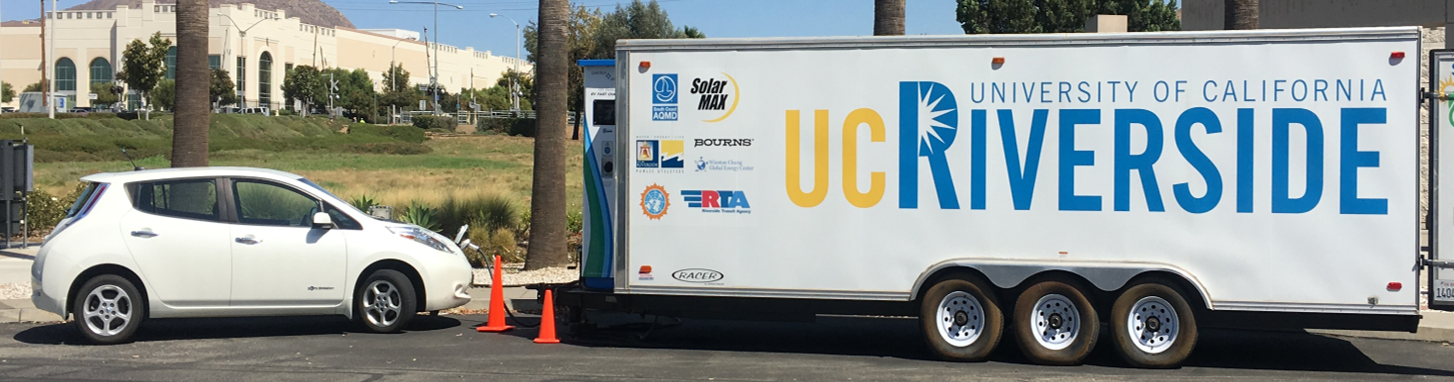 Original SIGI Mobile PlatformMobile Vehicle-to-Grid Battery TrailerExplore project
Overview
As part of a large Sustainable Integrated Grid Initiative (SIGI) research program, researchers have developed a unique mobile platform that can be used for a variety of vehicle charging experiments. The MV2GES platform is essentially a “microgrid on wheels” and consists of a trailer that has on-board energy storage (600 kWh), solar panels, grid-connectivity, and a V2G-capable EV charger that can be operated in an “islanded” configuration. This versatile platform can be used in several ways:
This platform is unique due to its Vehicle to Grid (V2G) charging capabilities coupled with islanding functionality. This allows grid connected vehicles to transfer power from the vehicles to transfer power from the vehicle back to the electric supply infrastructure. The optimization of V2G requires properly configured vehicles and electric vehicle supply equipment (EVSE). The platform can interface with both light-duty passenger EVs and larger transit electric vehicles. The MV2GES architecture allows stored energy support from either vehicle batteries or the trailer-based batteries. Algorithms contained within the on-board Energy Management System optimize based on load profiles, generated energy (solar PV), and stored energy. Coupling V2G functionality with electric transit vehicles has proven complementary since scheduled vehicle use provides dedicated vehicle availability for energy-based operations. Additionally, charging vehicles during excess energy supply (excess solar) allows energy to stay on site and minimize losses associated with electrical transmission/distribution. The MV2GES platform has proven effective in developing, demonstrating, and optimizing EMS strategies which can be deployed in regions needing greater energy resiliency coupled with expanded mobility options.
- Building microgrid support;
- Behind-the-meter energy optimization;
- Peak load mitigation;
- Demand responses;
- Islanding operations;
- Emergency power response;
- Coordinated community energy resiliency.
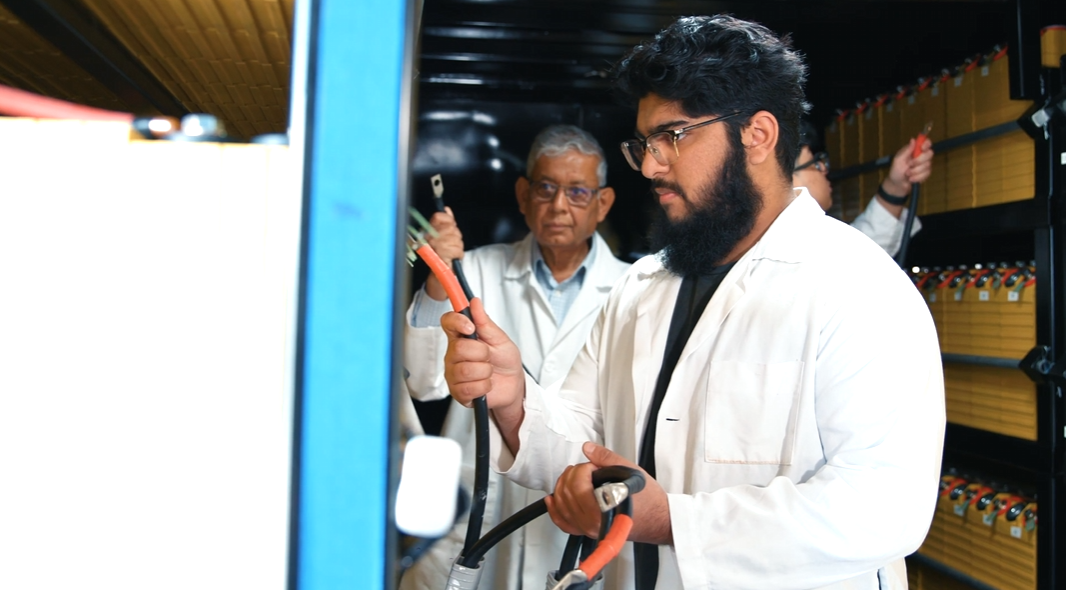 Newest SIGI Mobile PlatformMobile Renewable Backup Generation (MORBUG)Explore project
Overview
California’s recent increase in catastrophic wildfires combined with Investor Owned Utilities (IOU) and Public Safety Power Shutoffs (PSPS) requires stationary and/or backup generation. Traditional backup generation uses fossil fuel where small scale renewable sources like solar PV and wind are making some inroads.
For providing sustainable and reliable backup generation intermittent renewable energy need to be combined with Battery Energy Storage (BES) which require novel approaches for an integrated off grid system with enhanced resiliency and reliability.
The project team led by the College of Engineering-Center for Environmental Research and Technology (CE-CERT), has already developed extensive microgrid and BES integration of various sizes at our research center. These capabilities include mobile systems incorporating BES, solar PV, wind turbines and inverters. UCR now utilizes similar hardware and software solutions in collaboration with manufacturers of renewable energy generation products who have already implemented their products in small scale mobile platform.
The project team includes key partners that currently have commercial products which contribute system components that can help in developing a functional Mobile Renewable Backup Generation (MORBUG). The team’s approach is to optimize mobile renewable generation capability while maintaining complete transportation functionality and providing additional features such as advanced SCADA and EMS, critical load management utilizing on-site renewable generation.
Successful implementation of this system provides resilient and reliable electricity to the critical infrastructure during any rotating blackouts and PSPS incidents.
In the last ten years, the project team has designed, developed and deployed four working microgrids at UC Riverside. The primary microgrid testbed is located at UCR’s CE-CERT research facility, consisting of four buildings (totaling over 60,000 sqft), 500kW solar photovoltaic renewable energy generation, and over 500 kWh battery-based energy storage capacity. This testbed has been set up with a wide range of instrumentation and has a number of energy pathways to evaluate a variety of microgrid configurations. In the last two years, a number of experiments have been carried out for both off-grid islanding operation of the main administration building, as well as establishing V2G capabilities.
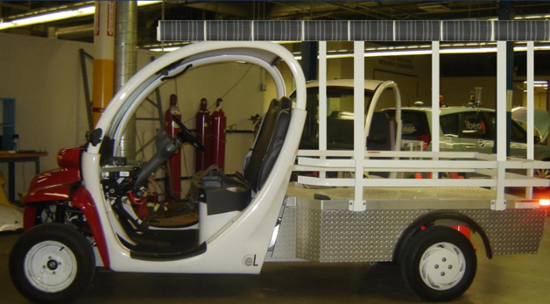 Solar-Powered Mobility DemonstrationSolar Global Electric Motor (GEM) VehicleExplore project
Overview
One of the major contributors to global climate change around the world is the carbon dioxide that internal combustion engine (ICE) vehicles produce. This issue deserves significant attention, leading to alternative energy sources and powertrains for transportation other than ICE vehicles. The purpose of this research project is to integrate solar electric power into a Neighborhood Electric Vehicle (NEV) car to demonstrate the possibilities that solar-electric vehicles can be a legitimate alternative transportation mode in the future. Eight solar panels have been installed on the roof and bed of the NEV in order to convert solar radiation into electric power. The electric power is used to power the vehicle during the day and to also recharge the batteries for later use. During the night, the NEV uses the energy saved in the six batteries that the vehicle uses. The goal of this project is to power the vehicle by at least 50% from solar power, the remaining power coming from the electric grid. Solar-electric vehicles can potentially be an efficient and clean source of energy for short trips in a community, producing zero exhaust emissions.
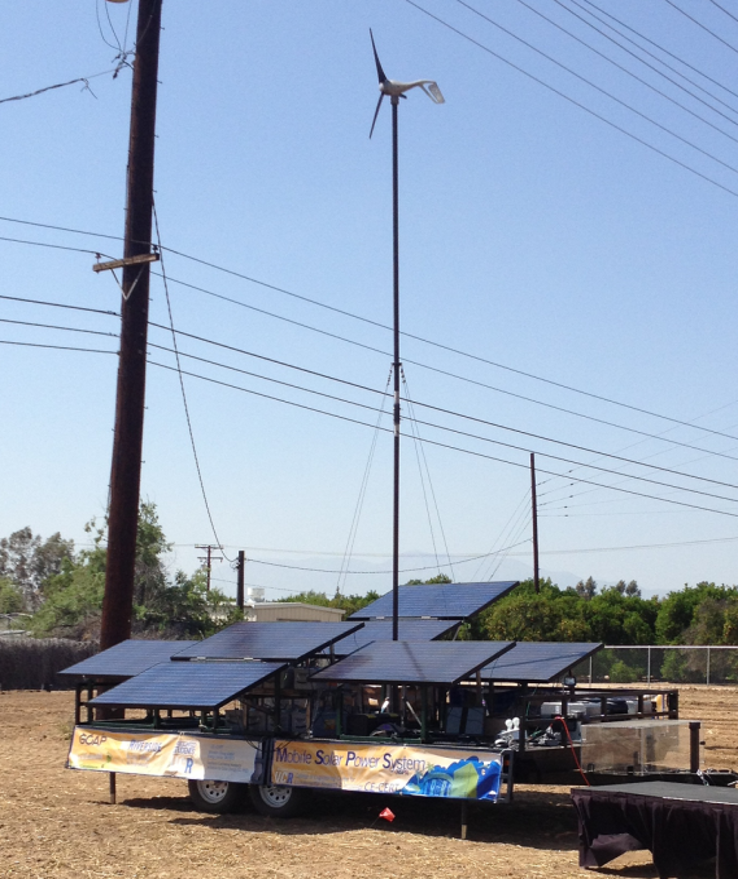 Portable Renewable Energy Mobile Renewable Energy Station (MRES)Explore project
Overview
The University of California-Riverside (UCR) has recently re-organized its Office of Sustainability, which oversees and supports all aspects of sustainability across campus. UCR, as part of the ten-campus University of California system, is following an aggressive Carbon Neutrality Initiative, committing the university to net-zero carbon emissions from all its activities, buildings, and vehicle fleet by the year 2025. UCR is applying much of its cutting-edge research and technology transfer to help achieve this goal, including bringing new zero-emitting vehicles and sustainable energy technologies and infrastructure to the campus.
Mobile Renewable Energy Station
A key student sustainability program at UCR is the Green Campus Action Plan, which is part of the associated student body. GCAP hosts a wide variety of programs that promote sustainability, including hosting workshops and events, carrying out “Green Projects”, and promoting sustainability practices on campus.
One of their goals is to maximize their use of renewable energy during outdoor events. Instead of plugging into the campus’ grid or using a diesel generator for their power, they will utilize a Mobile Renewable Energy Station that will collect, store, and deliver renewable electricity. Several years in the past, they created a prototype of such a system. They now have redesigned and created a new system. Assisting with this project will be several faculty and staff members from the CE-CERT.
Objectives
The primary objective of the proposed Mobile Renewable Energy Station (MRES) will be to replace the use of diesel generators for powering outdoor events at UCR. By switching to renewable solar energy, both GHG and pollutant emissions will be reduced. Once the system is designed and utilized, these emission reductions will be quantified. In addition, the MRES will serve as an educational showpiece to teach and demonstrate to students and the public about renewable energy and its capabilities.
Project Design
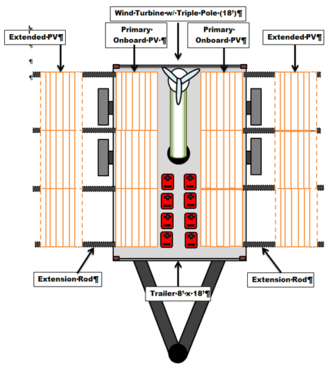
Mobile Renewable Energy Station Design
MRES consists of a trailer outfitted with different components that make up a renewable energy system, providing traditional 120V power. The system will capture solar energy through photovoltaic solar panels and optionally a wind turbine. The harvested energy is stored in a bank of rechargeable batteries. From there, the energy is directed through an electrical DC-to-AC inverter to power a variety of equipment. This MRES is used to power a number of future outdoor events, where it can also serve as a sustainability outreach tool, teaching students and the public how the system works and its current performance. This green energy project is an excellent way of generating electricity with zero carbon emissions and has near-zero operating costs.
The MRES is designed to provide enough power typically used at an outdoor event that can last up to three hours. It will be used to power lights as well as various audio-visual systems. A small tablet computer is also used as part of the MRES to illustrate the system operation and provide renewable energy statistics.
CE-CERT faculty and staff have extensive experience in this type of microgrid solution and will assist students in designing and building the overall system. The critical elements of the design will be the size of the solar panel assembly, battery system, and inverter. As part of the project, each component will be carefully designed to meet the specification goals of the project.
 Electric Transit DemonstrationBattery-Electric Trolley BusExplore project
Overview
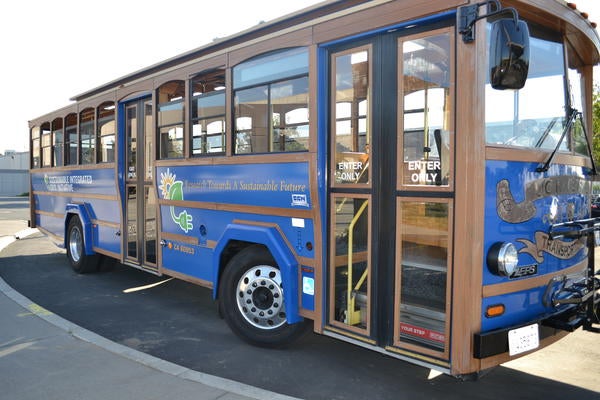
The Battery-Electric Trolley Bus can be connected to CE-CERT's micro-grid and is charged and discharged to manage our peak energy demand loads within our research facility. We can also utilize the Trolley for UCR and CE-CERT special events.

SIGI Is Part of CalTestBed
SIGI provides a real-world environment for evaluating emerging clean energy technologies through CalTestBed and California Energy Commission partnerships.
Faculty List
- Sadrul Ula, Research Faculty
- Matthew Barth, Professor of Electrical & Computer Engineering; BCOE Associate Dean for Research & Graduate Education
- Michael Todd, Principal Development Engineer
- Miroslav Penchev, Project Scientist
- Seungjin Lee, Postdoctoral Researcher
- Hamed Mohsenian-Rad, Professor of Electrical & Computer Engineering; CE-CERT Affiliate Faculty
- Emily Warmann, Research Faculty
Connect With SIGI
Connect with CE-CERT to discuss research collaboration, technology validation, microgrid and vehicle-to-grid research, field demonstrations, or access to SIGI capabilities.